
Did you just finish interviewing for your dream job and want to leave the hiring department with one last reason they should hire you above all the other candidates? Or maybe you are newer to the job search and interview process and are not sure what the protocol is.
Sending a follow-up letter after an interview is as important as placing a punctuation mark at the end of a sentence. You never want to exit an interview and leave a hanging gap of silence as you wait for the company to decide who to hire. Being pro-active and choosing to write an exceptional thank you letter will make you stand out to recruiters. These letters not only emphasize your commitment to and interest in the position you interviewed for, but acknowledge the time and effort spent by your interviewers to review your candidacy.
What Is an After-Interview Thank You Letter?
The Basics
An after-interview thank you letter is the correspondence you send after completing an interview to close out the interaction. This thank you letter gives you one last chance to make a deep impact on recruiters regarding who you are as a professional and why they should offer you the position.
Failing to send an after-interview thank you letter could be compared to wearing one shoe to your interview. You would never show up barefoot to meet the hiring department. Likewise, never fail to take the time to craft a personalized, thoughtful letter that provides you with one last opportunity to make your pitch and leave an indelible impression.
Additional Considerations
One aspect to remember is that crafting a thoughtful, well-written thank you note need not be difficult or even take an extraordinary amount of time. Use a modicum of words to make your points and express your thanks.
If you interviewed with more than one person, try to obtain everyone’s e-mail addresses before exiting the interview so you can send individual notes. If you will be sending your thank you letter via mail, take the time to write out individual letters to each person and send them at the same time.
Why Send a Followup Letter?
Express Your Gratitude
It may seem apparent, but the most important reason to send a follow-up letter after your interview is to express your gratitude and say thank you. The interviewers took time out of their busy days to meet with you and give you the chance to make your case, so saying thank you and showing appreciation for their efforts is essential.
Keep It Real
Along the same lines, be genuine in your composition, in order to write a professional but memorable thank you letter. Take the time to stand out and review some of the key points of the position you learned about in the interview in the body of your letter.
Reiterate your interest in the position, letting recruiters know that you are excited at the prospect of being given the opportunity to embody the role, support the company, and become involved in the work they are doing.
Acknowledge the Time Invested
We touched on this briefly earlier, but it is worth restating that your thank you letter should take a moment to recognize the time and effort expended on the part of your interviewer or interviewers. They took valuable intervals out their day not only to meet with you, but to prepare ahead of time. Let them know that you are appreciative of the time they took out of their day, showing them it was not wasted.
Make Your Case
Finally, one of the key reasons to send a thank you letter after your interview is to renew your interest in the job itself and show why you should be chosen in lieu of anyone else. Review the job requirements and identify a few key areas in your skill set relevant to the position.
Give examples of how you have applied your knowledge and expertise in the past and make it clear how this connects to the qualities they are looking for in this current role. You do not need to overstate your thanks or your qualities. A simple, concise, well-written thank you note goes much further than an essay. Add in a line relevant to the job description that identifies something previously untouched upon in your experience, or elaborates on a specific point discussed.
Be sure and check your work before sending it. Make sure it is free of errors or grammatical inconsistencies.
How to Write the Perfect Post-Interview Thank You Letter
It is often a good idea to send both an initial thank you note via email, and a follow-up afterwards via mail. Whether you decide to send one or both can be left to personal discretion, but it is a good idea to take the time to send each. If you send one over the other, it needs to be exceptional and pop. Take a few minutes to jot down notes as to what you would like to say and plan out your thank you letter.
Open your e-mailed thank you letter by greeting the interviewer by name. Depending on the tone of the interview you just had, it may be more appropriate to address the individual by their prefixed title and last name (i.e. Mr. Jones), rather than greeting them by their first name. Thank them for meeting with you and express your enjoyment at being given the chance to learn more about the role and meet the team. Identify the role by name.
It is a good idea to add in a line or two regarding something discussed in the interview that was specific to your interaction. Interviewers often meet with a significant numbers of candidates, so it is easy for contenders to get lost in the mix. Make sure you stand out and ensure there is no confusion as to which interviewee you are.
Add in a couple sentences summarizing your ideas about what you could offer to the job itself. Close out with a statement that you look forward to hearing from them regarding the next phase, and that they should contact you if they have any additional questions or need more information. Sign off with a strong and professional closer such as “Best Regards” or “Sincerely”.
Personalized Hand-Written Note
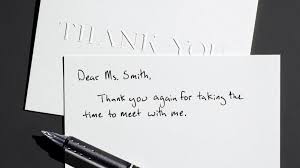
In formulating a hand-written thank you note, you will want to make sure that your writing is neat and fully legible. Take time to practice a few lines if need be before writing out the final result. If you are sending a hand-written thank you letter only, format it like the e-mail example noted above.
If you are sending it as a brief precursor to a more detailed e-mail, a few lines will do the trick. Simply address the interviewer and thank them for the time they took to speak with you regarding the particular position. Identity the name of the role itself and mention something specific that you were excited to learn about it or took away from the meeting. Let them know that you look forward to discussing the opportunity further and thank them one last time at the end. Close the note with a professional sign-off (i.e. “Best regards, Mary Thomas”).
Final Points
Whether you are sending your thank-you letter via mail or e-mail, it needs to be dispatched promptly after the interview. If you have time to send it out the same day of your interview, do so. Otherwise, it needs to be within a few days following your meeting.
For example, if you choose to send your letter in both forms, mail out the initial letter promptly. A few days later, send out the more detailed e-mail summarizing all the points discussed previously. You want to keep yourself at the forefront of the interviewer’s mind as they work to make a final decision or determine who will make the cut to the next round of interviews.
Balance out the identifying points regarding what you can offer with actual references to the requirements of the role itself. Your thank you letter should not be a lengthy resume. Instead, make it clear that you comprehend the demands of the role and the kind of person the company needs to embody it, tailoring your writing to serve that purpose.
Conclusion
Sending an after-interview thank you letter is an essential aspect of the job search process. The hiring managers will ultimately decide who they want to pick for a particular job. There are a host of varying factors that play a part in this. There may be many, equally qualified candidates vying for the position, all with something unique to offer to the role.
Therefore, while it may take a few tries to master or feel at ease with, this written follow-up is an invaluable closer to any interview. It gives you one last chance to express your thanks to the individuals who met with you, reiterate key points discussed, and show why you are the perfect fit for the role.