

Apart from home, employees spend a significant amount of time at the workplace, hence the need to know how to interact and understand their colleagues. Teamwork is crucial to the success of any company. Also, team-building exercises enhance cooperation, communication, and productivity and allow employees to know each other better.
The activities should be fun and challenging with the aim of improving particular skills among workers, e.g., problem-solving, communication, and decision-making. This article deliberates on ten important exercises and how they enhance team-building techniques.
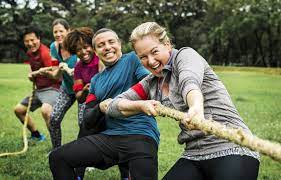
Image source: https://www.groupon.com/merchant/managing-your-business/employee-engagement/team-building-activities
1) Life Highlights Game
Here, the team leader asks the participants to close their eyes for a minute and reflect on the best moments of their lives. It may include moments they have shared with friends and family or those they have enjoyed alone, e.g., past successes, adventures or personal revelations.
He then asks the participants to decide on what thirty seconds of their life they would enjoy reliving if they had only a few minutes to live. The first part allows them to reflect on their lives while the second helps them to know their colleagues. He then asks each participant to share what their thirty-second reflection entailed, thus helping them understand each other’s passions and personalities.
2) Back-to-Back Drawing
The primary goal is to enhance the participants’ communication skills. The exercise requires pens, paper, and printouts of simple shapes. Ask the participants to split into pairs and sit back to back. One member holds the printout, and the other takes a piece of paper and a pen.
The idea is to provide verbal instructions to your partner as he tries to draw the shape given. Each pair then compares their images and identifies the team that drew the most accurate shape.
3) Truths and a Lie
The team leader instructs each team member to write down two truths and a believable lie. For example, they could write “I’ve not been to the moon;” they should not be offensive either. He then asks each group to read out their truths and lies and discuss them among the group members.
Truths and lies account for important team-building exercises that enhance communication and allow participants to know each other. Extroverts will have no problem revealing particular aspects about themselves, but introverts tend to remain bowled up.
4) Use What You Have
Here, the instructor divides the team into groups. He then gives each group a project with specific goals and restrictions. Each team uses the same supplies to complete the project within a particular period. The goal here is to enhance problem-solving skills and cultivate creativity among team members. It also creates fun and adds a twist to learning about how to solve a problem using limited resources. This is a great time management activity.
5) The Classification Game
The organizer must divide participants into different groups: morning people, those who love sushi, or sleeping late, etc.; the classification should be as subjective as possible. The instructor asks the participants to introduce themselves, citing their likes and dislikes.
After the introductions, the teams classify themselves in twos or threes in a nondiscriminatory or prejudicial criterion. The activity allows the participants to know each other.
6) Using Ideas as Building Blocks
The instructor creates a fictional problem (a riddle, brain teaser, or ideal product) that requires a solution. Gather the team and ask them to write down an idea of the solution on a piece of paper. Ask them to pass the paper to the next person who uses the new idea to develop another solution. The process should continue for a few minutes before asking to see the results.
Using ideas as building blocks account for important team-building exercises that help team members to appreciate everyone’s ideas. It is because most brainstorming sessions tend to sway to the most vocal and dominant individuals even when other members have valuable ideas.
7) The Minefield Game
You need boxes, water bottles, and office chairs to feign mines in a space, e.g., a hallway or an empty room. Divide the group into pairs where one participant is blindfolded. The other partner guides the blindfolded member from one end of the course to the other without setting off the mines.
He/she guides the “blind” partner using verbal instructions as he is not allowed to enter the course. This exercise encourages creative problem-solving and collaboration skills among participants.
8) A Created Economy
The instructor assembles the participants to create a mini-economy within the larger society. You set the rules they have to abide by, leaving ample room for the participants to experience problems that call for group agreement to solve them.
The mini-society allows the team to create problems that require them to work together. It reveals some team members as rule-abiders and others as creative problem solvers who bring a fresh understanding of solving work-related projects.
9) The Great Egg Drop
It is one of the oldest team-building exercises that help participants enhance their problem-solving and communication skills. The instructor asks the group to split into two large teams, each tasked with building an egg package that can sustain it from a ten-foot drop.
When the participants have made their packages, they are allowed thirty seconds to advertise their “product” and explain how it works. Each group drops their egg at the end of the presentation to see if it works.
10) The Perfect Square Game
Here, the instructor gathers the team in a circle, and the group team members are provided with a blindfold. A long rope is placed on each member’s hands and instructed to form a perfect square without removing the blindfold during the exercise.
Once the team believes it has built a square, it removes the blinds to see what they have created. It makes one of the many team-building exercises that deal with communication and leadership styles.
Summing It Up
Whether you want to enhance communication, problem-solving, teamwork, or leadership styles, the guide should help you pick the most appropriate team-building exercises. Some require a professional instructor while others are simple to execute. Develop a routine where participants perform new team-building exercises every time to avoid monotony.
Thanks for a comprehensive overview of various team-building exercises. How does HR Development Info recommend tailoring team-building exercises to suit the specific needs and challenges of different types of teams?